Aether Cannons
New Life as a Max Level ArchmageAether Cannons are the Convoy’s principal defensive weapons: mana-powered artillery mounted along the armored train to protect passengers traveling through the monster-infested reaches of Prismarche. They embody both the Convoy’s immense engineering and its dangerous dependence on a centralized power system. When the engine car is torn away, the cannons remain visible and technically functional, but their firepower collapses to a fraction of its intended strength. Their eventual reactivation through emergency power cores turns them from decorative remnants of a failed defense into the instrument that prevents the Convoy from being immediately overrun.
Design and Defensive Function
The Convoy is larger than ordinary trains, squat and blocky, and covered in armor thick enough to stop a cannonball. Aether Cannons are positioned in turrets every few cars, with mana visibly thrumming through their mechanisms. Their mounts appear capable of pivoting, presumably under the control of operators stationed below, allowing the weapons to engage threats approaching from different directions rather than merely firing along the railway. The arrangement makes the Convoy resemble a moving fortress built for a route where ordinary transportation would be indefensible.
The cannons are necessary because the Convoy crosses thousands of miles of dangerous territory and reaches remote parts of Prismarche where monsters are an expected hazard. Their intended capacity is far beyond the threats that ordinary passengers could manage. Saffra understands them as weapons meant to handle dangers above the Titled rank, which explains why she initially assumes that the passengers can simply shelter inside the train while the artillery deals with an attack. The cannons therefore create an expectation of security: the Convoy is not merely armored against the wilderness but equipped to answer it with overwhelming magical force.
The Engine-Car Failure
That expectation collapses when the Ghul-Feather disables the engine car and removes the Convoy’s main power cores. Jasper explains that the visible cannons have become, in his bitter phrase, “Just for decoration.” He qualifies the statement by noting that they may still generate enough power to deal with some mithril-level monsters and weaker creatures before they sputter out, but they can no longer deliver the force for which they were designed. The adventurers who had not known about the engine car’s role react with horror, and Saffra realizes that the Convoy has an obvious single point of failure despite the engine car being heavily fortified.
The failure is especially dangerous because the Ghul-Feather itself is level 1200, far beyond what the weakened artillery can reliably stop. The monster cannot immediately penetrate the Convoy’s hull, whose metal remains extraordinarily resilient, but it can disable the system that makes the train’s defenses meaningful. This contrast separates physical durability from operational security. The Convoy survives the monster’s assault as a structure, yet its defensive network is nearly helpless because its power source has been severed.
The cannons are not completely useless after the attack. Four healers establish themselves near the one functioning artillery position, while the other turrets are disabled because they have been planted into the ground. Later, as the monsters gather, the upright cannons release bursts of elemental magic, primarily lightning. Their attacks are described as light slaps where they should have been sledgehammer blows, but even that reduced output probably prevents the Convoy from being overrun immediately. The weapons thus occupy an unstable middle state: too weak to restore safety, yet still strong enough to buy the survivors time.
Emergency Power and Saffra’s Intervention
The Convoy contains emergency power slots elsewhere, making recovery possible without reconnecting the entire engine car. Jasper identifies the Lounge as the relevant location and tells Saffra that there are eight slots, though he is uncertain whether the sockets are in the floor and admits that he may have overstated his understanding of the Convoy’s workings. His plan is deliberately limited: Saffra should take only two of the eight gray power cores, place them in her inventory if possible, and return them to the emergency slots. Two cores should be enough to power the cannons while leaving the Ghul-Feather interested in the engine car and its remaining treasure.
The plan is made urgent by the spreading assault. Lower-level monsters have already charged into the defenses, while stronger creatures, including orichalcum-level monsters, wait at a distance and gather the nerve to attack. Jasper divides the adventurers into teams along the upright portion of the Convoy and leaves to reduce the approaching monsters, while Saffra crosses the exposed terrain toward the Lounge. The cannons’ reduced firepower makes every delay consequential: they are not a complete defense but a temporary margin in which the survivors must repair their position.
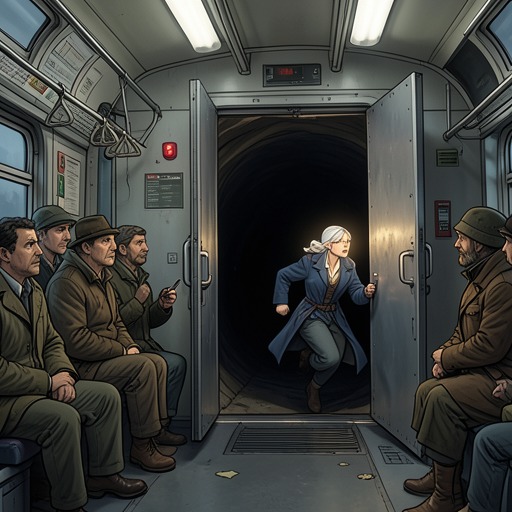
Inside the compartment, the eight slots are set into a metal face covered with artificing lines resembling those in the engine car. When the inert gray cores approach, an invisible force pulls them from Saffra’s hands and locks them into the sockets. She then pulls the lever. The train shudders as mana floods into the system; the gray orbs turn white, hum with power, and send energy through the Convoy. The brilliance of the restored cores provides immediate confirmation that the emergency system has accepted the replacement power and that the cannons can once again draw on a meaningful energy supply.
Narrative Significance
The Aether Cannons organize the Convoy attack around a tension between apparent invulnerability and hidden dependence. From the outside, the armored train seems capable of crossing a hostile continent: its hull resists the level-1200 Ghul-Feather, its turrets can rotate, and its artillery is expected to answer threats beyond Titled rank. Yet the removal of one fortified car exposes how narrowly that security is engineered. The cannons’ failure reveals that technological or magical scale does not eliminate vulnerability; it can merely conceal the point at which the entire system depends.
Their temporary degradation also makes the Convoy’s defense a collective rather than purely mechanical achievement. Adventurers search wrecked carriages, healers treat the injured near the surviving turret, Jasper organizes the response, and Saffra retrieves the cores despite her fear that using so much of Vivi’s potion has already ended her apprenticeship before it begins. The cannons become the meeting point of these efforts. They cannot save the passengers without people willing to fight for time, repair the power supply, and carry out a dangerous retrieval mission.
The restoration is therefore both a technical reversal and a rite of emerging competence for Saffra. She approaches the emergency slots while monsters assault the Convoy and while the Ghul-Feather remains close to the stolen treasure. Once the lever is pulled and the cores flare white, the artillery’s return to power marks the first concrete success in a crisis that had seemed to be moving toward slaughter. The Aether Cannons are not merely equipment in the scene: they are the visible measure of the Convoy’s remaining hope, and their change from brilliant promise to failing defense and back toward operational strength gives the attack its clearest mechanical and dramatic shape.